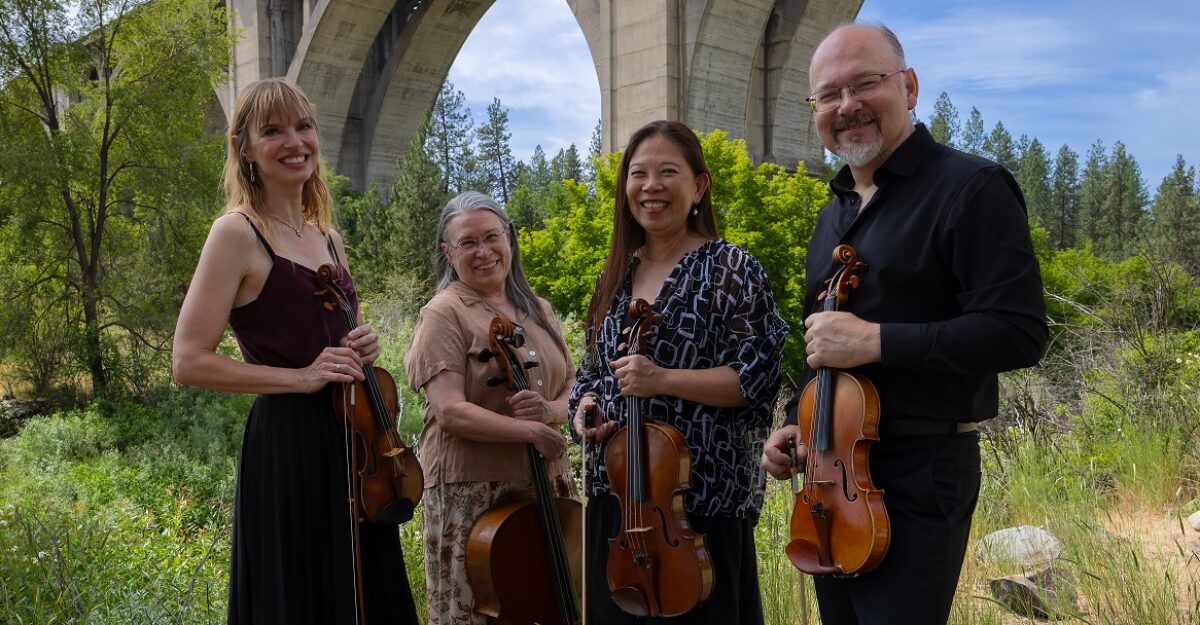
The Spokane String Quartet opens its 2026-27 season with pianist Frank Huang in two performances: 7:30 p.m. Friday, Sept. 25, at Schuler Performing Arts Center at North Idaho College in Coeur d’Alene, and 2 p.m. Sunday, Sept. 27 (NEW CONCERT TIME THIS SEASON), at The Fox Theater in Spokane.
Tickets for the Sept. 25 concert at North Idaho College in Coeur d’Alene will be available at the door; online ticketing information will be added soon.
Tickets for the Sept. 27 concert at The Fox Theater will be available through The Fox website and at the door; the ticket link will be added soon.
The program features pianist Frank Huang, double bassist Kim Plewniak and the Spokane String Quartet performing music by Franz Liszt, Antonín Dvořák and Franz Schubert.
The program includes:
- Franz Liszt: Totentanz, S. 525, for solo piano
- Antonín Dvořák: Piano Trio No. 4 in E minor, “Dumky”
- Franz Schubert: Piano Quintet “Trout”, with Kim Plewniak, double bass
Pianist Zhengyi (Frank) Huang is currently pursuing a Doctor of Musical Arts degree at the University of Michigan, where he previously earned master’s degrees in Piano Performance and Chamber Music. He also holds an Artist Diploma from Rice University’s Shepherd School of Music, where he studied with Jon Kimura Parker. Huang has received first prizes in more than 30 competitions since 2022 and has appeared as soloist with the Grand Junction Symphony Orchestra, Richardson Symphony Orchestra and Flint Symphony Orchestra. His recent concert and masterclass appearances have taken him throughout the United States, Asia and Europe.
About the program
Hungarian composer Franz Liszt (1822-1886) achieved unprecedented popularity, termed ‘Lisztomania’, as a virtuoso touring pianist. Liszt’s Totentanz for Piano Solo (1847) is considered one of his most challenging piano solo pieces to perform. Totentanz (Dance of Death) references the medieval tale of people from all ages and social strata being summoned to dance with Death. Liszt utilizes the Dies Irae (Day of Wrath) theme, from the medieval Gregorian Chant depicting Judgment Day, as the starting point for a dramatic set of variations. Liszt is among the many classical and film score composers drawn to the Dies Irae theme and its association with approaching death.
Antonín Dvořák (1841-1904) subtitled his Piano Trio No. 4 “Dumky”, which references traditional Ukrainian folk ballads lamenting hardships in their Cossack past. Dvořák chose to contrast the slow and melancholic songs of Dumky by alternating them with lively dance rhythms, like in the Bohemian dance Furiant. Therefore, Dvořák’s version of Dumky involved rapid changes between contrasting soulful and exuberant music. He initially used Dumka (the singular form) as a single movement within the four-movement classical structure. However, Dvořák abandoned conventional classical form in Piano Trio No. 4, which consists entirely of six complete Dumka movements. Dumky Trio was so successful following its premiere with Dvořák playing piano (1891) that he performed the Trio over 40 more times throughout Bohemia and Moravia as part of a ‘farewell concert tour’ before leaving his beloved Czech homeland for America.
The genesis of Franz Schubert’s (1797-1828) Piano Quintet “Trout” traces back to young Schubert (22 years old) leaving Vienna for just his second time to hike the Austrian Alps for the summer with his friend, baritone Johann Vogel, who premiered many of Schubert’s Art Songs. While there, Schubert met a music patron at soirees, who commissioned him to write a quintet using Schubert’s song “Die Forelle” (“The Trout”) for a set of variations for piano, violin, viola, cello, and double bass. The resulting quintet is a masterpiece brimming with joyful melodies. The music appears to effortlessly capture the environment surrounding Schubert — majestic nature bathed in sunshine, the delights of friendship and soiree conviviality, and the spirit of carefree youthful freedom.