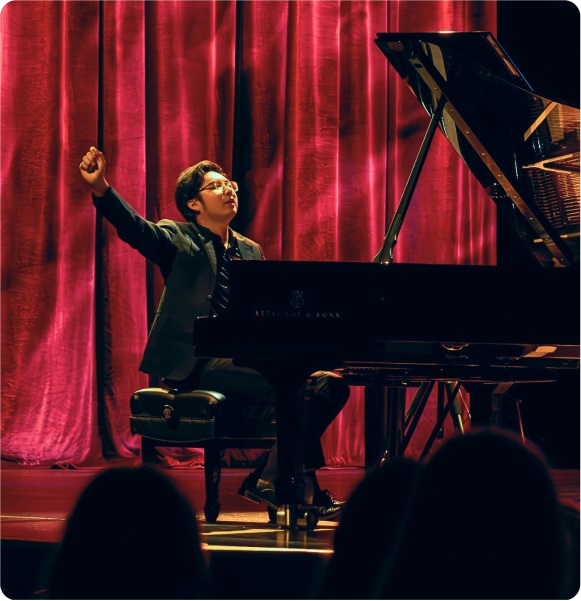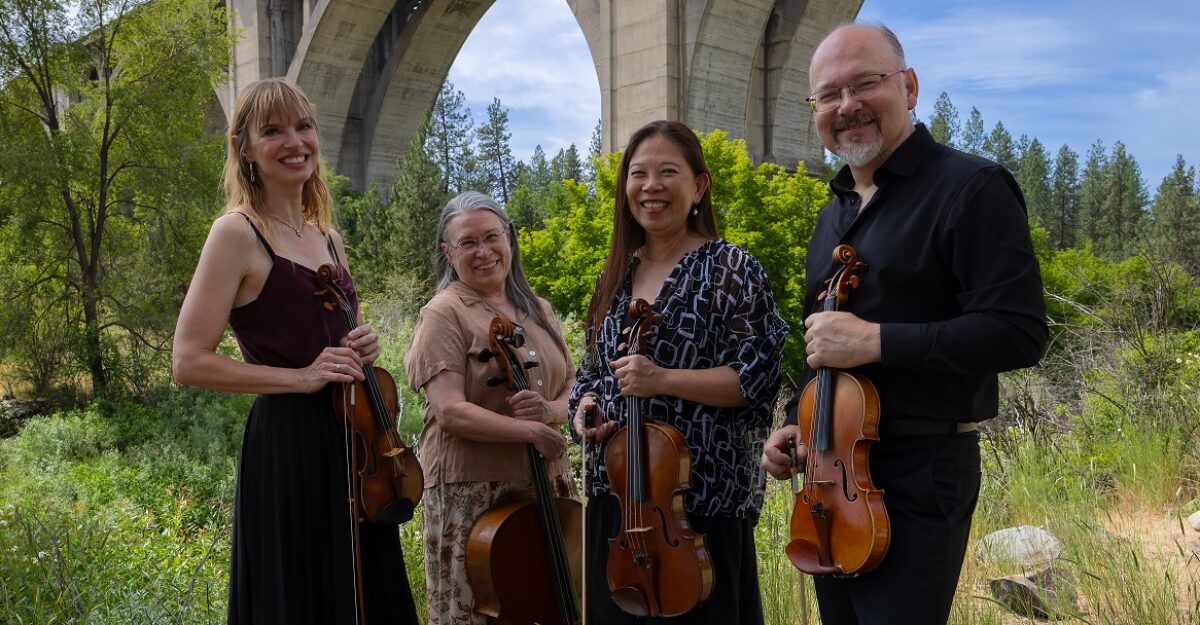
SSQ opens ’26-27 season Sept. 25 and 27 with pianist Frank Huang

The Spokane String Quartet opens its 2026-27 season with pianist Frank Huang in two performances: 7:30 p.m. Friday, Sept. 25, at Schuler Performing Arts Center at North Idaho College in Coeur d’Alene, and 2 p.m. Sunday, Sept. 27 (NEW CONCERT TIME THIS SEASON), at The Fox Theater in Spokane.

Tickets for the Sept. 25 concert at North Idaho College in Coeur d’Alene will be available at the door; online ticketing information will be added soon.
Tickets for the Sept. 27 concert at The Fox Theater will be available through The Fox website and at the door; the ticket link will be added soon.

The program features pianist Frank Huang, double bassist Kim Plewniak and the Spokane String Quartet performing music by Franz Liszt, Antonín Dvořák and Franz Schubert.

The program includes:

  • Franz Liszt: Totentanz, S. 525, for solo piano
  • Antonín Dvořák: Piano Trio No. 4 in E minor, “Dumky”
  • Franz Schubert: Piano Quintet “Trout”, with Kim Plewniak, double bass

Pianist Zhengyi (Frank) Huang is currently pursuing a Doctor of Musical Arts degree at the University of Michigan, where he previously earned master’s degrees in Piano Performance and Chamber Music. He also holds an Artist Diploma from Rice University’s Shepherd School of Music, where he studied with Jon Kimura Parker. Huang has received first prizes in more than 30 competitions since 2022 and has appeared as soloist with the Grand Junction Symphony Orchestra, Richardson Symphony Orchestra and Flint Symphony Orchestra. His recent concert and masterclass appearances have taken him throughout the United States, Asia and Europe.

About the program

Hungarian composer Franz Liszt (1822-1886) achieved unprecedented popularity, termed ‘Lisztomania’, as a virtuoso touring pianist. Liszt’s Totentanz for Piano Solo (1847) is considered one of his most challenging piano solo pieces to perform. Totentanz (Dance of Death) references the medieval tale of people from all ages and social strata being summoned to dance with Death. Liszt utilizes the Dies Irae (Day of Wrath) theme, from the medieval Gregorian Chant depicting Judgment Day, as the starting point for a dramatic set of variations. Liszt is among the many classical and film score composers drawn to the Dies Irae theme and its association with approaching death.

Antonín Dvořák (1841-1904) subtitled his Piano Trio No. 4 “Dumky”, which references traditional Ukrainian folk ballads lamenting hardships in their Cossack past. Dvořák chose to contrast the slow and melancholic songs of Dumky by alternating them with lively dance rhythms, like in the Bohemian dance Furiant. Therefore, Dvořák’s version of Dumky involved rapid changes between contrasting soulful and exuberant music. He initially used Dumka (the singular form) as a single movement within the four-movement classical structure. However, Dvořák abandoned conventional classical form in Piano Trio No. 4, which consists entirely of six complete Dumka movements. Dumky Trio was so successful following its premiere with Dvořák playing piano (1891) that he performed the Trio over 40 more times throughout Bohemia and Moravia as part of a ‘farewell concert tour’ before leaving his beloved Czech homeland for America.

The genesis of Franz Schubert’s (1797-1828) Piano Quintet “Trout” traces back to young Schubert (22 years old) leaving Vienna for just his second time to hike the Austrian Alps for the summer with his friend, baritone Johann Vogel, who premiered many of Schubert’s Art Songs. While there, Schubert met a music patron at soirees, who commissioned him to write a quintet using Schubert’s song “Die Forelle” (“The Trout”) for a set of variations for piano, violin, viola, cello, and double bass. The resulting quintet is a masterpiece brimming with joyful melodies. The music appears to effortlessly capture the environment surrounding Schubert — majestic nature bathed in sunshine, the delights of friendship and soiree conviviality, and the spirit of carefree youthful freedom.

Season tickets on sale for 2026-27 season

Season tickets are on sale for the Spokane String Quartet’s 2026-27 with some changes to go along with the first-class chamber music that has been provided for 48 years.

There is a NEW CONCERT TIME this season. All concerts will start at 2 p.m. with the exception of Friday, Sept. 25 concert at NIC in Coeur d’Alene, which will start at 7:30 p.m. Season ticket prices will be $120 for adults and $100 for seniors. Individual concert tickets are $30 for adults and $25 for seniors. Youth under 18 and students with ID are admitted free. Season tickets are on sale now; tickets for individual concerts go on sale at a later date.

Click here to purchase season tickets.

The season begins with two performances featuring pianist Frank Huang: Friday, Sept. 25, at Schuler Performing Arts Center at North Idaho College in Coeur d’Alene, and Sunday, Sept. 27, at The Fox Theater in Spokane.

The program includes:

  • Franz Liszt, Totentanz, S. 525, solo piano
  • Dvořák, Piano Trio No. 4 in E minor “Dumky”
  • Schubert, Piano Quintet “Trout”, with Kim Plewniak on double bass

Other concerts at The Fox are Sunday, Nov. 1, Sunday, Feb. 14, and Sunday, April 11, with the Vytal Movement Dance Company. The season concludes Sunday, May 23, at the Bing Crosby Theater with oboist Keith Thomas.

SSQ concert March 8 features Montero, Tchaikovsky, Beethoven

Guest cellist Calvin Kung joins the Spokane String Quartet for music from around the world at its next concert at 3 p.m. Sunday, March 8, at The Fox Theater.

Click here to buy tickets.

All seats are general admission. Tickets are $25 for adults, $20 for seniors and free for under 18 and students with ID.

Kung, in his first year as assistant principal cello with the Spokane Symphony, will be guest cellist for today’s concert. A native of the Bay Area, Kung is a graduate of UCLA and the San Francisco Conservatory of Music, with degrees from both institutions in cello performance. The program takes the audience to both sides of the Atlantic and include works by Grammy-winning composer Claudia Montero from Argentina, Pyotr Tchaikovsky from Russia and Ludwig van Beethoven from Germany.

About the concert:
Argentine Composer Claudia Montero (1962-2021) was born and raised in Buenos Aires, surrounded by the many styles of tango music and dance uniquely expressed in the different neighborhoods of this vibrant city. Tango emerged in late 19th century working-class, multicultural communities of Buenos Aires, and represents the cultural fusion of African rhythms, native Argentine dances, and European immigrant influence (introducing the accordion-like bandoneon and other instruments). The tango has evolved over time, and composers Astor Piazzolla and Montero have brought tango music styles from the bars and dance halls into the concert hall. Montero’s Cuarteto para Buenos Aires captures the spirit of the city by alternating tango rhythms with faster milonga rhythms. Her Cuarteto was awarded the 2016 Latin Grammy for “Best Contemporary Classical Composition”.

Pyotr Ilyich Tchaikovsky’s (1840-1893) three string quartets were written during the early stages of his composing career while he was teaching harmony for 12 years at the newly founded Moscow Conservatory. When String Quartet No. 2 was composed in 1874, Tchaikovsky wrote: “I regard it as my best composition; no other piece has flowed out of me so simply and easily. I wrote it almost in one sitting.” The quartet utilizes the conventional four movement formal structure of a Classical period string quartet yet is filled with innovative and introspective Romantic era tendencies. Tchaikovsky would describe the emotional authenticity of the quartet emerging “spontaneously from the very depths of my soul.”

Ludwig van Beethoven’s (1770-1827) String Quartet No. 7 was the first of three Opus 59 string quartets commissioned by Count Andreas Razumovsky, Russian Ambassador to Vienna during the Napoleonic Wars. Beethoven composed the Opus 59 quartets during the peak of his “Heroic” middle period, which reflects the creative surge following his Heiligenstadt Testament resolve to rise above the despair of increasing deafness through composing the unrealized groundbreaking music still within. Like the earlier iconic masterpieces of his “Heroic” period (including the Eroica Symphony, Kreutzer Sonata, and Piano Concertos No. 3 and 4), the Opus 95 Razumovsky Quartets were vastly larger in scale, complexity, and emotional depth than anything previously composed in the genre. Beethoven’s revolutionary musical explorations provided the bridge from the Classic period to the Romantic era and beyond.

SSQ welcomes 2026 with super concert Feb. 8

The Spokane String Quartet launches the 2026 portion of its season at 3 p.m. Sunday, Feb. 8, with a concert at The Fox Theater featuring works by Franz Joseph Haydn, Béla Bartók and Robert Schumann.

Click here to buy tickets.

All seats are general admission. Tickets are $25 for adults, $20 for seniors and free for under 18 and students with ID.

The Feb. 8 program includes:
• Franz Joseph Haydn: String Quartet No. 66 in G Major, Op. 77, No. 1 (Hob. III:81)
• Béla Bartók: String Quartet No. 1 in A Minor
• Robert Schumann: String Quartet No. 1 in A Minor, Op. 41, No. 1

Pianist Yoon-Wha Roh joins SSQ for Nov. 2 concert at The Fox

The Spokane String Quartet continues its 2025-26 season with an appearance by pianist Yoon-Wha Roh at 3 p.m. Sunday, Nov. 2, at The Fox Theater.

Pieces by contemporary composer Jihyun Kim and 19th century composer Felix Mendelssohn will replace previously announced works by Ludwig van Beethoven and Leoš Janáček.

All seats are general admission and are $25 for adults, $20 for seniors and free for under 18 and students with ID. Purchase tickets at The Fox Theater ticket office or at this link.

The concert opens with Four Images for Piano by Jihyun Kim, who is on the faculty at Washington State University. The piece is followed by Mendelssohn’s Piano Trio No.1 in D MInor, Op. 49. It is one of Mendelssohn’s most popular chamber works and will be presented by Roh and SSQ violinist Amanda Howard-Phillips and cellist Helen Byrne. After the intermission, Roh, Howard-Phillips, Byrne and SSQ violist Jeannette Wee-Yang will present Piano Quartet No. 1 in C Minor by Gabriel Fauré.

Yoon-Wha Roh has been acclaimed by the Hyde Park Herald as “a pianist who lets her piano work do the talking, transporting her audience not only to a clearly defined place, but also into a colorful adventure.” She performs around the world as a celebrated concert pianist with upcoming concerts in Malaysia, Spain and Korea. She is also an active chamber musician and is a sought-after clinician and competition judge. She is currently assistant professor of piano at Washington State University.

SSQ opens season Sept. 28 with flutist Julia Pyke

The Spokane String Quartet opens its 2025-26 season with an appearance by Julia Pyke, principal flute for the Spokane Symphony, at 3 p.m. Sunday, Sept. 28, at The Fox Theater.

All seats are general admission. Tickets are $25 for adults, $20 for seniors and free for under 18 and students with ID. Tickets are available at this link or at the door.

Sunday’s program includes Gabriela Smith’s unconventional conteporary piece “Porcupine Wash,” Amy Beach’s Theme and Variations for Flute and Strings, Wolfgang Amadeus Mozart’s Flute Quartet No. 1 in D Major, K.285, and Carl Nielsen’s String Quartet No. 1 in G Minor, Op. 13.

Last fall Pyke was featured soloist when the Symphony performed Christopher Rouse’s Flute Concerto. She has also performed with the Oregon Symphony, the New World Symphony and members of the Cleveland Orchestra and the San Francisco Symphony. When she’s not playing the flute, Julia enjoys rock climbing, hiking, running, cooking and singing. In the spring of 2024, she made her theater debut as Grizabella in Spokane Civic Theater’s production of “Cats.”

About the program

With the acclaimed Boston Symphony Orchestra premieres of her “Gaelic” Symphony (1896) and Piano Concerto (1900), Amy Beach (1867-1944) became the first successful female American composer of large-scale symphonic music. During an age of gender bias and the woman’s suffrage movement, Beach became symbolic proof that women could creatively work and excel at the highest level in every field. The main theme from Beach’s “Theme and Variations for Flute and Strings” comes from her song “An Indian Lullaby” which depicts her romanticized impression of native life. Beach also studied authentic indigenous music, such as Inuit music collected in Labrador, to use in her musical exploration of “What is American Music?” 

For 33-year-old Gabriella Smith, her lifelong passion for music, ecology, and play have creatively merged to compose sonic landscapes inspired by nature. She has been described as an environmentalist composer. Although deeply aware of climate change impacts and biodiversity loss, she sees her music as a call to action and the joy of working within communities on climate solutions. She delights in exploring new instrumental sounds by using extended techniques. In “Porcupine Wash” she prepares the strings by inserting paper clips to create her desired sounds. 

Wolfgang Amadeus Mozart wrote that “Melody is the essence of music.” Mozart’s Flute Quartet No. 1, composed in 1777 at a youthful age 21, showcases his gift for creating music brimming with melodies of delightful beauty. The Flute Quartet is written in the “concertante” style, which features the flute taking a prominent solo role, with the strings providing vibrant accompaniment. 

Carl Nielsen (1865-1931) from Denmark was among the major Nordic composers gaining prominence at the turn of the 20th century, including Edvard Grieg (Norway) and Jean Sibelius (Finland). They all shared a deep attachment to their homeland and its folk traditions. Nielsen’s String Quartet No. 1 was the first of four string quartets he composed. Though considered a youthful work, the quartet’s spirited rhythms, melodies and Danish folk-influenced harmonies all foreshadow Nielsen’s emerging dynamic voice well on the path to becoming one of Denmark’s finest composers.

Season tickets on sale for 2025-26 season

Season tickets are now on sale for the Spokane String Quartet’s 2025-26 season. Patrons on our mailing list should expect their season brochure in the mail the week of Aug. 4. Season tickets will be mailed to subscribers beginning in September.

All seats are general admission for the String Quartet’s 3 p.m. Sunday concerts. A season-ticket package costs $100 for adults and $80 for seniors and gives you five concerts for the price of four. Persons under 18 and students with ID are admitted free. Tickets for individual concerts will go on sale in September.

Season tickets may be purchased online here or you may download an order form here to be returned by mail.

The new season opens Sept. 28 at The Fox Theater with guest artist Julia Pyke, who plays principal flute for the Spokane Symphony. The season continues Nov. 2 at The Fox Theater with concert pianist Yoon-Wha Roh, who is on the faculty at Washington State University.

After a break for the holidays, the season continues Feb. 8 at The Fox Theater with a program of music by Haydn, Bartok and Schumann. Then, on March 8 at The Fox Theater, soprano Dawn Wolski will be guest performer for Jake Heggie’s “Camille Claudel: Into the Fire,” based on the life of the late 19th and early 20th century sculptor linked romantically with Auguste Rodin.

The season concludes May 17 at the Bing Crosby Theater with guest cellist Calvin Kung sitting in with the Quartet.

For season ticket questions, email spokanequartet@gmail.com or call marketing director Garry Matlow at 509-998-2261.

Concert dates announced for SSQ’s 2025-26 season

The dates are set for the five subscription concerts in the Spokane String Quartet’s 2025-26 season.

The season opens Sunday, Sept. 28, at The Fox Theater. Additional concerts at The Fox will be Nov. 2, 2025, and Feb. 8 and March 8, 2026. The season will conclude at the Bing Crosby Theater on May 17.

Look for the season brochure with concert details and ticket ordering information in the mail later this summer.

Hornist Clinton Webb joins SSQ for season finale May 18

The Spokane String Quartet finishes its 2024-25 season with an appearance by Clinton Webb, principal horn for the Spokane Symphony, at 3 p.m. Sunday, May 18, at the Bing Crosby Theater.

All seats are general admission. Tickets are $25 for adults, $20 for seniors and free for under 18 and students with ID. Tickets are available at this link or at the door.

Webb will join the Quartet for Wolfgang Amadeus Mozart’s Quintet for Horn and Strings in E-flat, K.407. He is in his second year in Spokane after stints in Tulsa and Flint, Michigan. Unlike a typical horn quintet, Mozart’s piece calls for a solo horn along with a violin, two violas and a cello. Replacing the second violin with a second viola fills out the middle range of the ensemble and melds with the horn.

Also on the program are Three Essays by contemporary Grammy-winning composer Caroline Shaw and String Quartet in B-flat major, Op. 67, by Johannes Brahms.